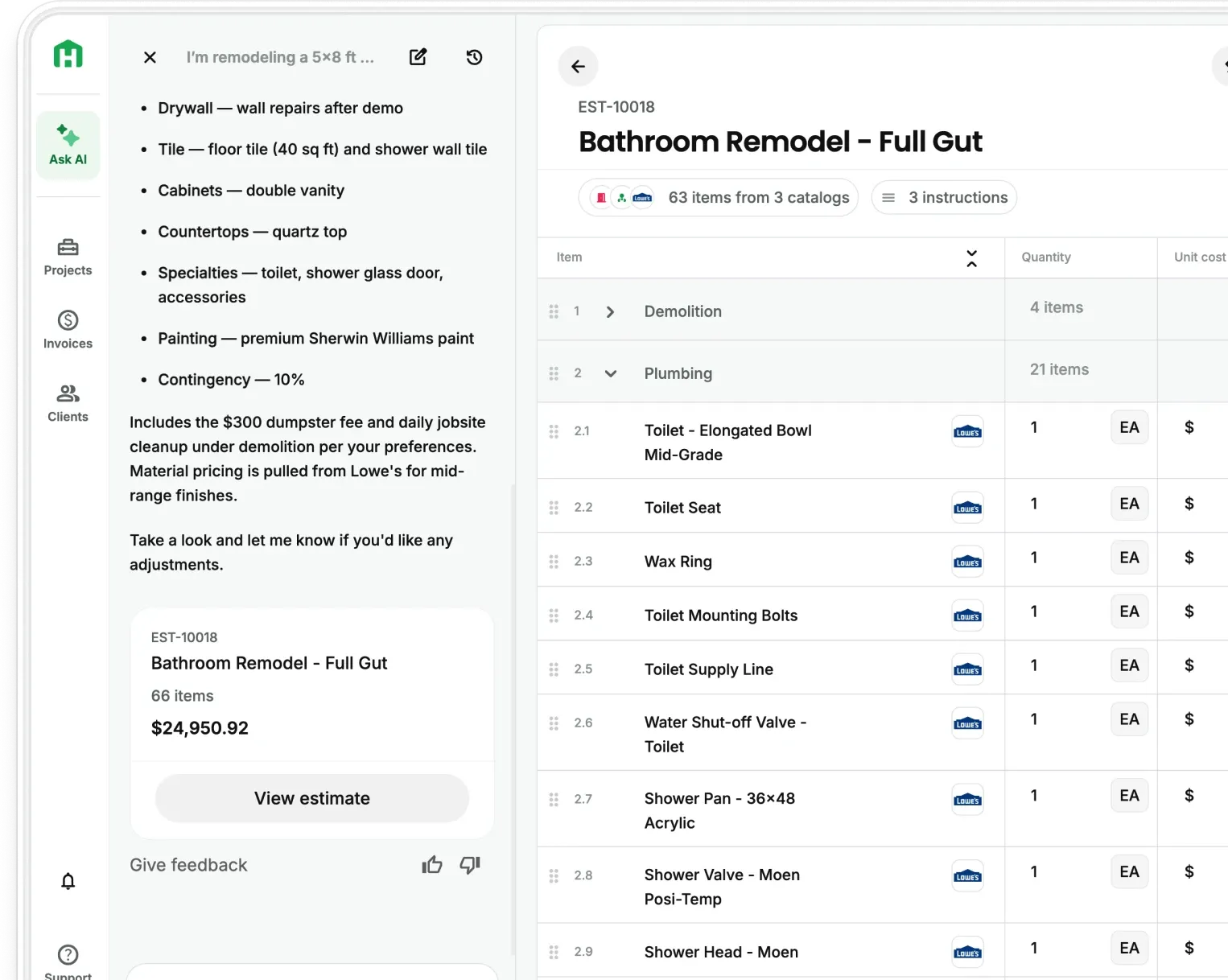
Manual estimating — printing plans, running takeoffs by hand, building spreadsheets from scratch — is no longer competitive for residential contractors. The contractors winning more bids today are combining their field experience with AI estimating tools that handle the slow, error-prone parts of the bidding process. Here's why the old model breaks down, and what the shift actually looks like in practice.
The real cost of manual estimating for residential contractors
What it costs you that doesn't show up on a spreadsheet
Most contractors lose jobs because the estimating process takes too long, makes too many small errors, and burns hours that should be going toward the work itself.
- Manual takeoffs average 3–5 hours per estimate for a mid-size remodel, according to NAHB research on contractor time allocation
- Material prices change daily. A spreadsheet built last week can already be off before you send the bid
- A single missed line item — a permit fee, a demo cost, a scope detail from the site walk — comes out of your margin after the contract is signed
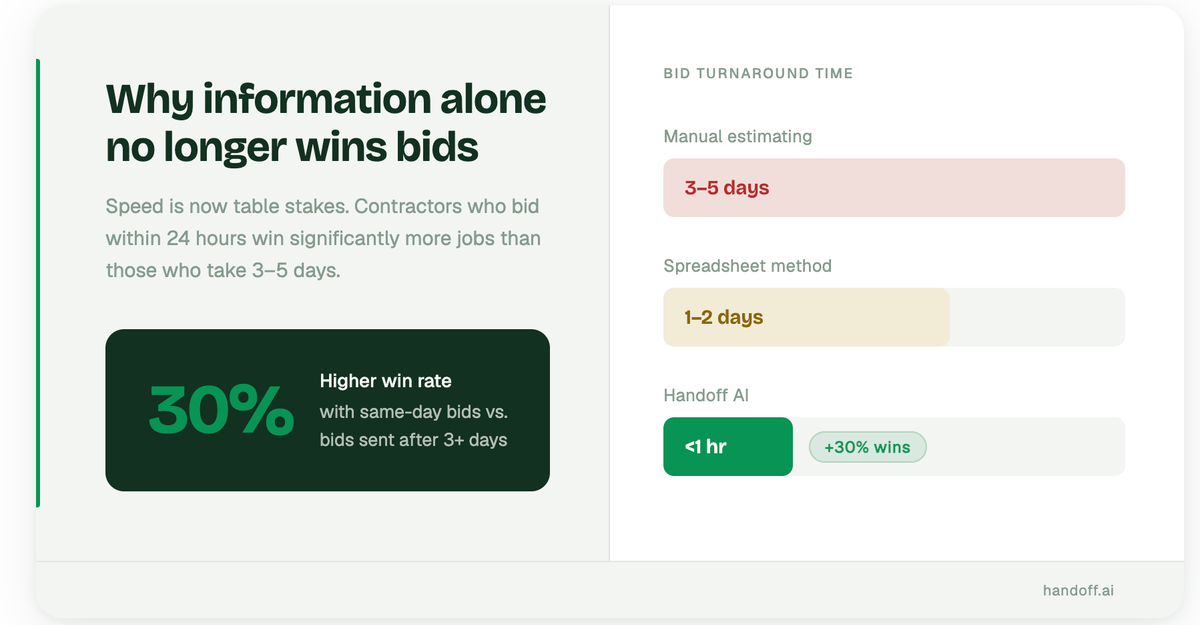
- Slow turnaround directly costs jobs: contractors who respond to bid requests within 24 hours win at significantly higher rates than those who take 3–5 days, per NARI industry data
The problem isn't effort. It's that the process is built around your time, not your expertise. And your time is finite.
Three estimating approaches that don't scale
Why the most common methods all hit the same wall
Before getting into the new model, it helps to name the old ones honestly. Most residential contractors are still running one of three approaches and all three share the same core flaw.
- Manual takeoff: You print the plans, measure every line, and build the estimate from scratch. Thorough, but completely capped by the hours in your day. If bidding takes 15–20 hours a week, you're not running a business — you're running a treadmill.
- Spreadsheet system: Better than a blank page, but spreadsheets only do what you tell them. They don't update material prices, flag a missing line item, or catch a formula error before it wipes out your margin.
- Gut-feel pricing: Works in a stable market. In today's environment of volatile lumber costs and tight labor supply, pricing from memory on a job you haven't fully scoped is a margin risk on every single bid.
All three models were built for a slower market where the contractor with the most knowledge had the edge. That edge has eroded. Speed and accuracy are now table stakes.
Manual estimating vs AI estimating for remodelers
What actually changes when contractors switch
The shift to AI estimating isn't about replacing what you know. It's about removing what slows you down. Here's what the difference looks like in practice:
- Takeoff time: Manual takeoffs average several hours per project. AI reads the same plans, photos, or scope description and builds a line-item estimate in minutes — with your pricing and markup already applied
- Material pricing: Manual estimates pull from last month's supplier quote or a remembered price. AI pulls live pricing from real supplier data, updated daily by ZIP code
- Scope coverage: Manual estimates depend on memory from the site walk. AI analyzes photos and plans and surfaces items that get missed — the kind of omissions that turn profitable jobs into break-even ones
- Proposal output: Manual estimates still need to be formatted into a client-ready document. AI generates the proposal automatically from the estimate
According to JBKnowledge's Construction Technology Report, contractors using AI-assisted estimating tools report significant reductions in bid preparation time and improved accuracy on material quantities. Your AI Teammate handles the calculation work so you can spend that time on the job site, with clients, or on the next lead.
The three ways estimates fail before the first nail is driven
Winning the job is only half the equation. The estimate sets whether you make money on it. AI estimating protects margins in specific, measurable ways:
- Eliminates calculation errors — automated math means no bad formulas, no transposed numbers, no markup applied to the wrong subtotal
- Catches missed scope items — your AI Teammate flags potential omissions before the bid goes out, not after you've already committed to the price
- Uses live pricing — no more estimates built on material costs from last quarter; pricing updates daily so your numbers reflect what you'll actually pay at the supply house
- Keeps markup consistent — your rates and markup rules are locked in once and applied automatically across every estimate, whether you're writing the bid or someone on your team is
For a deeper look at where margins actually leak on residential jobs, see how modern contractors protect profit margins on remodeling jobs.
Accurate estimates protect contractor margins from the first line item to the final invoice.
What AI estimating can't replace
AI handles the math. It doesn't handle the judgment.
- Walking a job site and spotting a problem before it becomes a $20,000 surprise — that's you
- Reading a client in the first five minutes and knowing how to position your price — that's you
- Knowing which subcontractor to call when the schedule shifts — that's you
- The relationship, the reputation, the trust you've built over years of showing up — that's yours
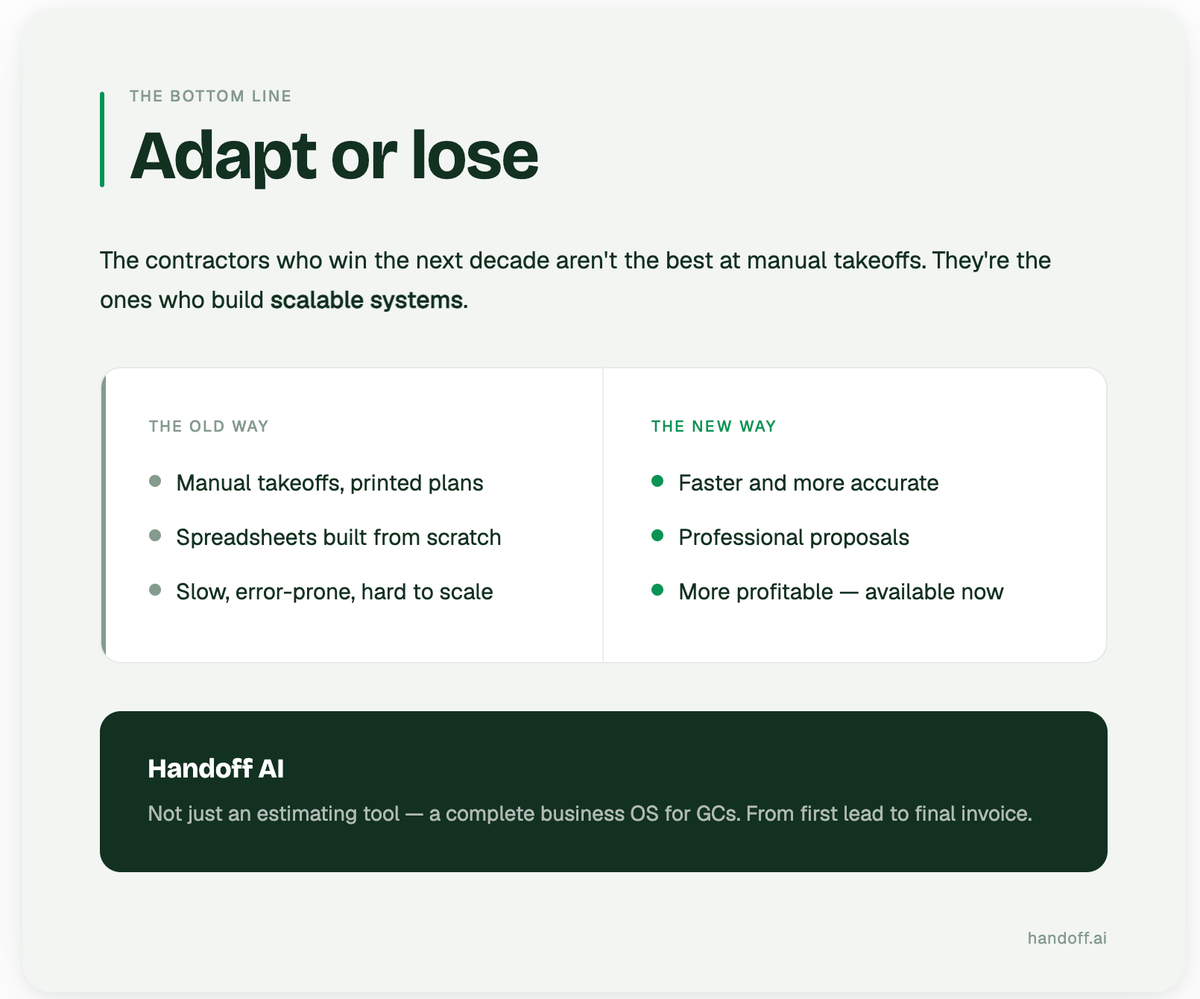
In a world where AI is handling the calculation work, those field skills become more valuable, not less. The contractor who combines hands-on experience with AI-powered tools isn't just competitive — they're operating in a different tier than the ones still running spreadsheets. Small remodeling contractors who use Handoff compete with larger firms without adding headcount or overhead.
Getting started with AI estimating
If you're ready to make the shift, here's where to start:
- Go to handoff.ai/sign-up and start a free 7-day trial — no credit card required
- Run your first estimate: describe a project you're currently bidding, upload a photo from a recent site visit, or import a set of plans
- Compare the result to your manual estimate — note what your AI Teammate caught that you might have missed
- Send the proposal directly from Handoff — formatted, branded, and ready for the client
- Track your turnaround time — same-day bids close at a higher rate than bids that take 3–5 days
For more on what the transition actually looks like, read how to use AI to estimate your construction projects and 5 ways AI estimating software pays for itself on the first project.
Manual estimating is a systems problem. Handoff fixes the system.
More FAQs on manual vs. AI estimating
Is AI estimating accurate enough to use on real residential jobs?
Yes. Multiple contractors report AI-generated estimates coming in within a few hundred dollars of actual project costs on typical remodeling work — kitchens, bathrooms, additions. The accuracy comes from real construction data calibrated to local markets and updated daily, not national averages from a generic database.
How long does it take to learn AI estimating software?
Most platforms, including Handoff, are built to have you creating your first estimate within an hour of signing up. If a tool requires weeks of training or IT support to implement, it won't stick. Handoff is built specifically for residential contractors — the workflow follows how you already think about jobs, not how enterprise software manages projects.
Will using AI estimating make my bids less competitive on price?
The opposite tends to be true. Faster turnaround means more bids submitted per week — and more bids is the single most reliable way to win more work without lowering your prices. Contractors who respond within 24 hours win at significantly higher rates than those who take longer, regardless of price.