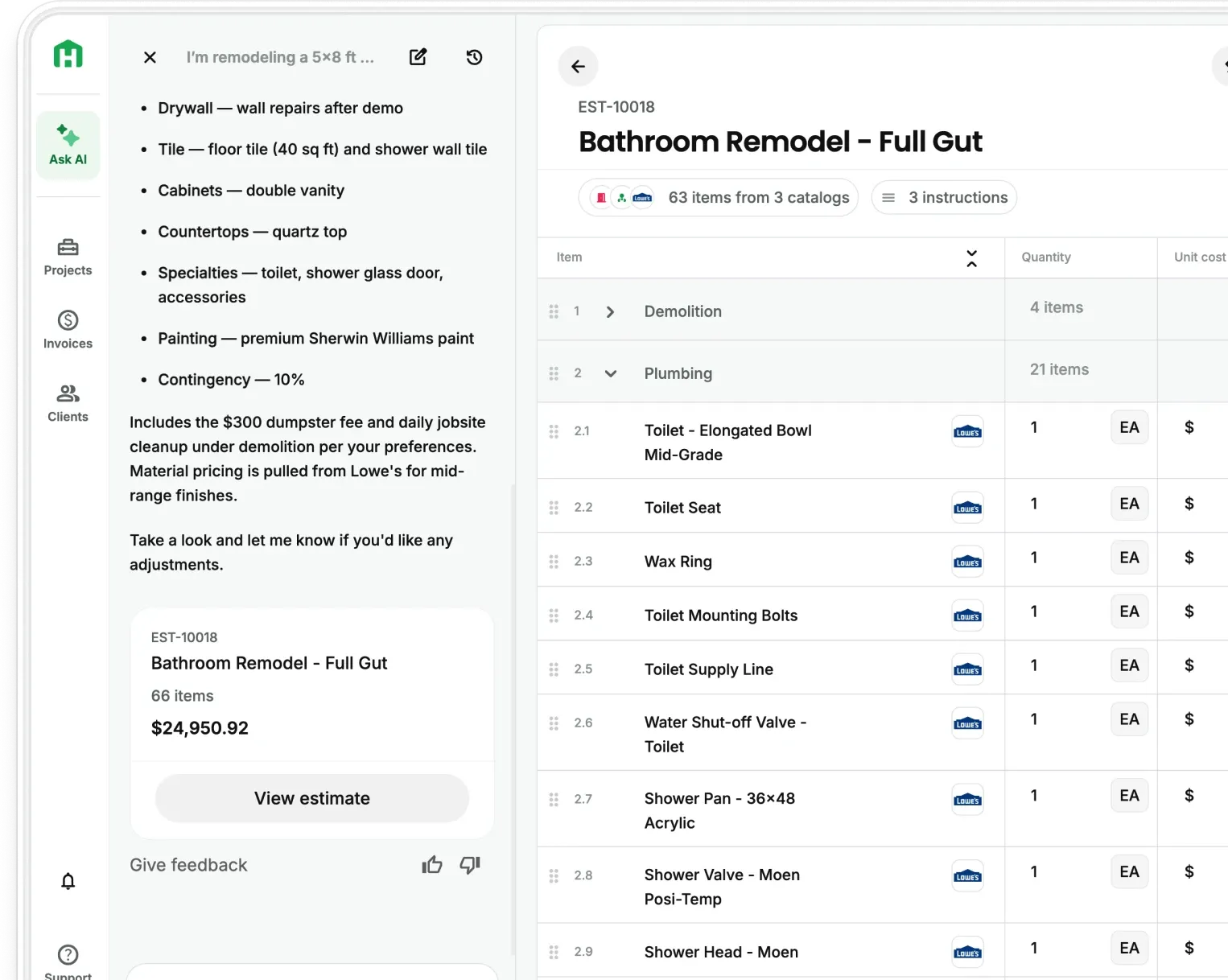
Qualifying a construction lead comes down to four things: timeline, budget, decision-maker, and scope. Ask about all four in the first conversation and you'll know within five minutes whether the job is worth a site visit. Most contractors skip this step — and spend 40+ hours a month chasing leads that were never going to close.
Here's how to do it right.
Why contractors waste time on bad leads
A lead comes in, it sounds promising, and before any real questions get asked, a site visit is already on the calendar. Research from RAIN Group has found that sales professionals waste up to 50% of their time on prospects who were never going to buy.
The leads that drain the most time tend to look the same:
- A homeowner gathering prices with no intention of starting for 18 months
- A prospect with a $12,000 budget asking for a $40,000 kitchen
- A spouse calling without the other decision-maker involved
- Someone who had a bad experience and is looking for someone to listen
None of these are bad people. They're just not the right lead right now. A qualification process catches them before the drive across town.
Your AI Teammate can track which leads converted and which didn't so over time, your pipeline stops filling with the wrong ones.
Four questions to ask clients before scheduling a site visit
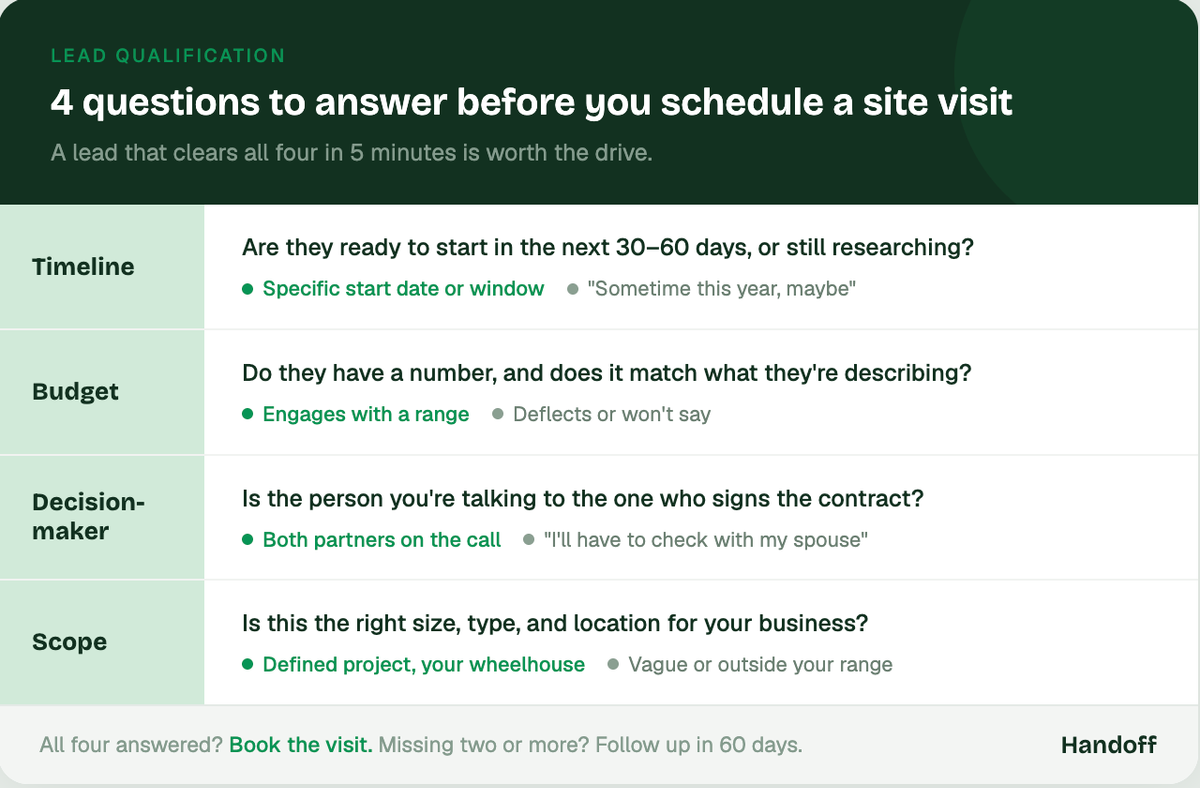
You don't need ten questions to qualify a lead. You need honest answers to four.
- Timeline: Are they ready to start in the next 30–60 days, or are they still researching?
- Budget: Do they have a number in mind, and does it match the scope they're describing?
- Decision-maker: Are you talking to the person who signs the contract, or do they need to check with a spouse?
- Scope: Is this project actually in your wheelhouse — right size, type, and location?
A lead that clears all four in the first five minutes is worth a drive. One that can't answer any of them isn't ready yet. And following up in 60 days costs nothing.
Getting these four answers consistently is what separates contractors with a 40% close rate from contractors with a 15% close rate.
How to ask about budget without making it awkward
Budget is the question most contractors skip. It feels pushy. The result is two hours on a site visit for a job that was never going to fit. The fix is framing budget as a service to the homeowner, not a filter for yourself.
- "I want to make sure I put together something that actually works for you — do you have a rough number in mind, or do you want me to give you a range first?"
- "Projects like this typically run between X and Y depending on materials and scope. Does that fit where you're thinking?"
- "Have you looked into financing, or are you planning to pay out of pocket?"
Budget conversations go sideways when they feel like a test. Framed as part of scoping the job, most homeowners will answer honestly. If they won't engage with the question at all, that's information too.
How to tell between a serious lead vs. just shopping around
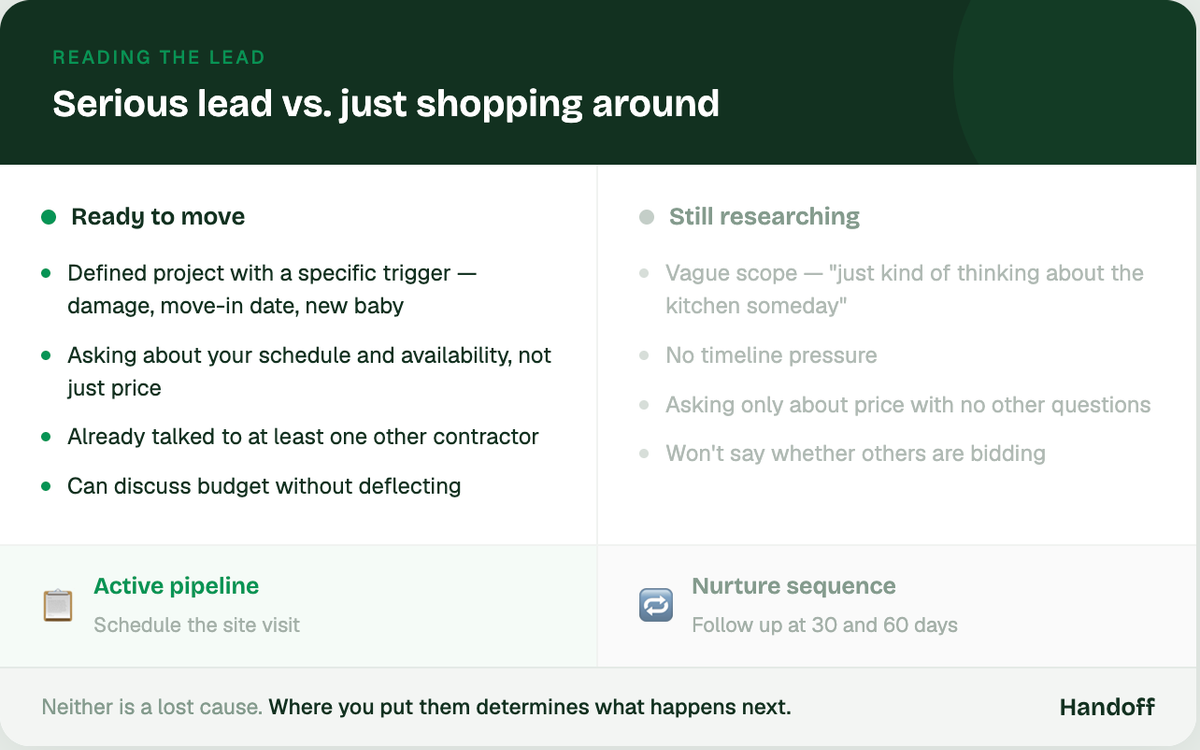
Most homeowners who reach out are somewhere between "just curious" and "ready to sign next week." Your job is to figure out where. Not to push everyone toward the end before they're ready.
Signs a lead is ready to move:
- They have a defined project with a specific trigger — an event, damage, a new baby, a move-in date
- They're asking about your schedule and availability, not just your price
- They've already talked to at least one other contractor
- They can discuss budget without deflecting
Signs they're still in research mode:
- Vague scope ("just kind of thinking about redoing the kitchen someday")
- No timeline pressure
- Asking only about price with no other questions
- Won't say whether others are bidding
Neither category is a lost cause. Serious leads go into your active pipeline. Research-phase leads go into a follow-up sequence. A check-in at 30 and 60 days costs almost nothing and converts a real percentage when they're ready.
3 ways to pre-qualify leads before the first call
The most efficient qualification happens before you pick up the phone. A short intake form on your website — four to six questions about project type, timeline, budget range, and how they found you — filters the tire-kickers and gives you context before the first conversation.
Walker Home Remodeling uses a simple pre-qualification form that collects the basics without overwhelming the lead. The form doesn't close every job. But it means every conversation starts with a baseline.
- Set up an automated email for new leads that covers your process, typical project types, and what to expect. Leads who engage are more likely to be serious
- Use a CRM with contact records tied to each lead so nothing falls through between first contact and site visit
- Build a simple follow-up cadence: day 3, day 7, day 14 — for leads that go quiet after initial contact
Your AI Teammate tracks every lead and sends follow-ups automatically, so the leads you worked to get don't disappear because the job site got busy.
5 lead qualification mistakes that kill close rates
Even experienced contractors make these. They feel harmless in the moment — until they add up.
- Talking to the wrong person — Scheduling a site visit without confirming both decision-makers will be there means starting qualification over from scratch
- Skipping the budget conversation — Avoidance doesn't protect the relationship. It just delays the problem until after the estimate is written
- Missing the red flags — A lead who is difficult, vague, or dismissive in the first five minutes rarely gets easier once the project starts
- No follow-up system — According to NAHB research, most homeowners contact multiple contractors before deciding. Contractors who follow up consistently win a disproportionate share of those jobs
- Not tracking lead sources — If you don't know where your best leads come from, you can't put more resources behind them
The contractors who close the most jobs aren't necessarily the best salespeople. They're the ones with a consistent process that keeps good leads from going cold.
Getting started qualifying leads with Handoff
- Create your free account at app.handoff.ai/sign-up
- Set up contact records for every active lead so nothing falls through the cracks
- Use your AI Teammate to build and send proposals the same day as the site visit
- Set follow-up reminders so qualified leads don't go cold while you're on the job site
- Track which lead sources are producing your best close rates over time
Wasting hours on the wrong leads is not a hustle problem. It's a process problem. Handoff fixes the process.
Other FAQs about qualifying leads in your pipeline
Should contractors always ask about budget on the first call?
Yes. Framed as helping the homeowner get an accurate proposal — not screening them out — the budget question lands well in most cases. Skipping it doesn't protect the relationship. It just delays a conversation that was going to happen anyway, usually after you've already spent time on a site visit and a written estimate.
What's a realistic close rate for a residential remodeling contractor?
Private residential work typically benchmarks at 40–50% for referral leads and 10–15% for paid lead platforms like Angi or HomeAdvisor. If your overall close rate is below 20%, the issue is usually lead quality or a gap in the follow-up process — not the estimates themselves. Our lead generation guide covers how to build a healthier pipeline from the start.
How many leads should a small remodeling contractor be qualifying per month?
Volume matters less than source quality. The more useful metric is close rate by lead source. If referrals close at 4x the rate of a lead platform, your pipeline mix and qualification effort should reflect that — not treat every lead the same way.