Most contractors who lose bids don't lose them on price. They lose them on speed, professionalism, and follow-through. All things that have nothing to do with how good the work is. The contractors winning at higher rates are doing a handful of things differently before, during, and after the proposal goes out.
Here's what actually moves the needle on bid win rates for residential remodelers.
Why most contractors lose bids before the client reads the number
A homeowner reaching out to three or four contractors has already started forming opinions before anyone sends a proposal. How fast you responded. Whether your website had recent project photos. Whether the site visit felt organized. By the time they open your estimate, the decision is often halfway made.
The most common reasons contractors lose work that should have been theirs:
- Responding to the inquiry a day or two late. By then the client has already had a good conversation with someone else
- Showing up to the site visit without knowledge on the property or the scope
- Sending a lump sum or a rough number via text instead of a structured proposal
- Going quiet after submitting. No follow-up, no check-in, nothing
The contractors winning these jobs consistently are the most responsive and the most organized.
Bid-hit ratio for contractors — what it is and why it matters
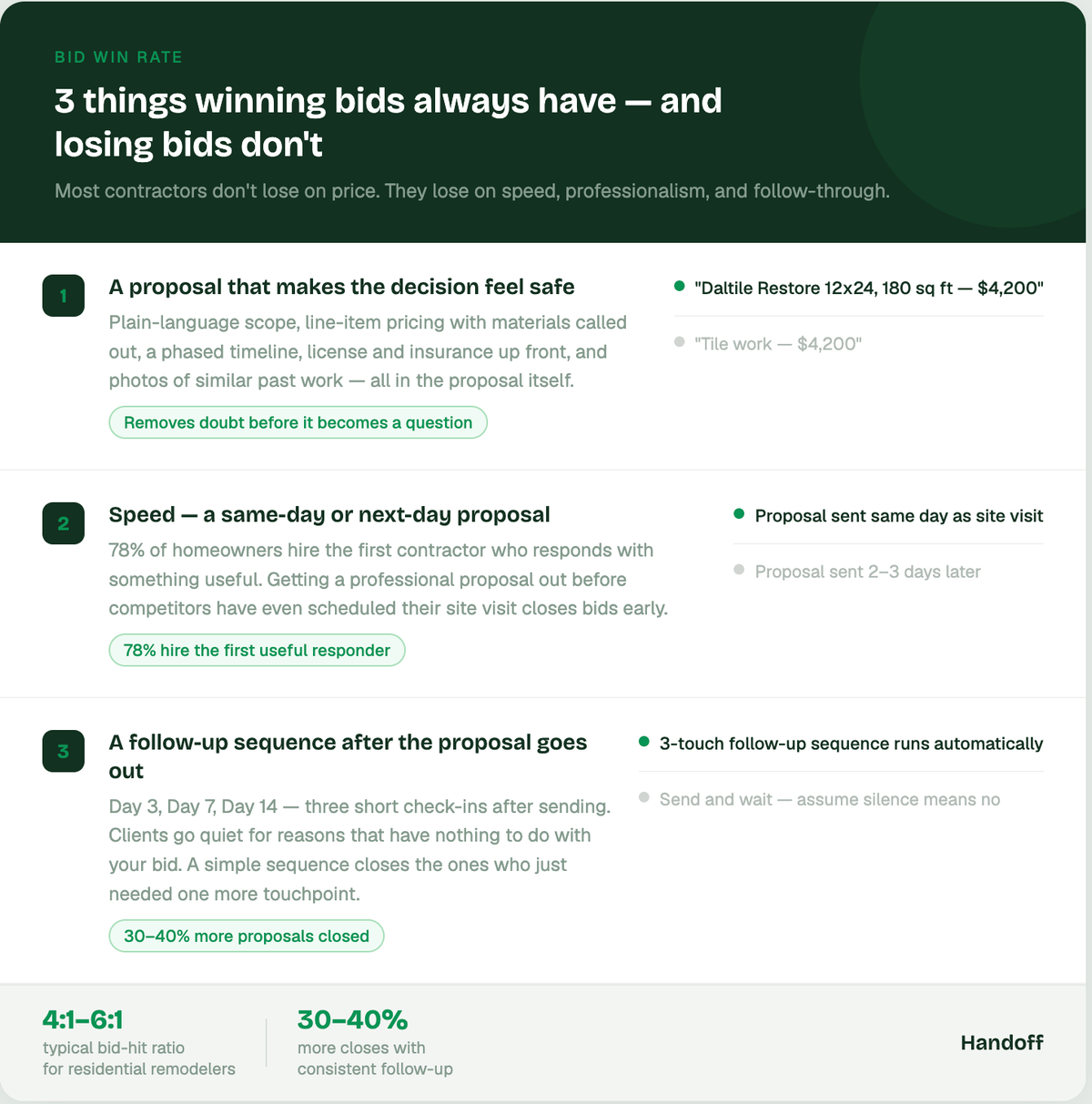
Your bid-hit ratio is the number of bids you submit divided by the number you win. If you submit 10 proposals and close 2, your ratio is 5:1. Industry benchmarks for private residential work typically sit between 4:1 and 6:1 — meaning you win roughly one in four to one in six bids.
The ratio itself matters less than what you track alongside it. Break your bids down by:
- Project type — kitchens, bathrooms, additions, full remodels
- Lead source — referral, Google, lead platform, direct outreach
- Job size — under $20K, $20K–$75K, over $75K
- Geography — neighborhoods or service zones you bid in
Most contractors who do this for a quarter discover that 70% of their wins come from 30% of their bid categories. The job types they win most often are usually the ones they're best at and most known for. The ones they keep losing are often outside that zone — wrong job size, wrong lead quality, wrong neighborhood.
Tracking this doesn't require software. A simple spreadsheet with five columns changes how you bid within 90 days. Stop bidding everything. Start bidding what you win. For help filling that pipeline with better-fit jobs in the first place, the lead generation guide for contractors is worth bookmarking.
What separates winning proposals from ones that get ignored
A homeowner who receives three proposals on the same day will read all three. The one that wins isn't always the lowest. It's usually the one that makes the decision feel safest.
What a winning proposal includes:
- A clear scope narrative — not just line items, but a plain-language description of exactly what's included and what isn't. Clients worry about surprises. Remove that worry upfront.
- Line-item pricing with materials called out — a proposal that shows "$4,200 — tile labor and materials (Daltile Restore 12x24, 180 sq ft)" reads as more trustworthy than "$4,200 — tile work"
- A realistic timeline with phases — demo week, rough-in, finish work, punch list. Clients who can visualize the schedule feel more in control of a project they're nervous about
- Your license, insurance, and warranty terms — not buried in fine print. Stated clearly near the top. Homeowners shopping multiple contractors are looking for reasons to eliminate people. Make it easy to trust you instead.
- Two or three photos of similar past work — in the proposal itself, not just on your website. The client reviewing your bid at 9pm shouldn't have to go find evidence that you've done this before
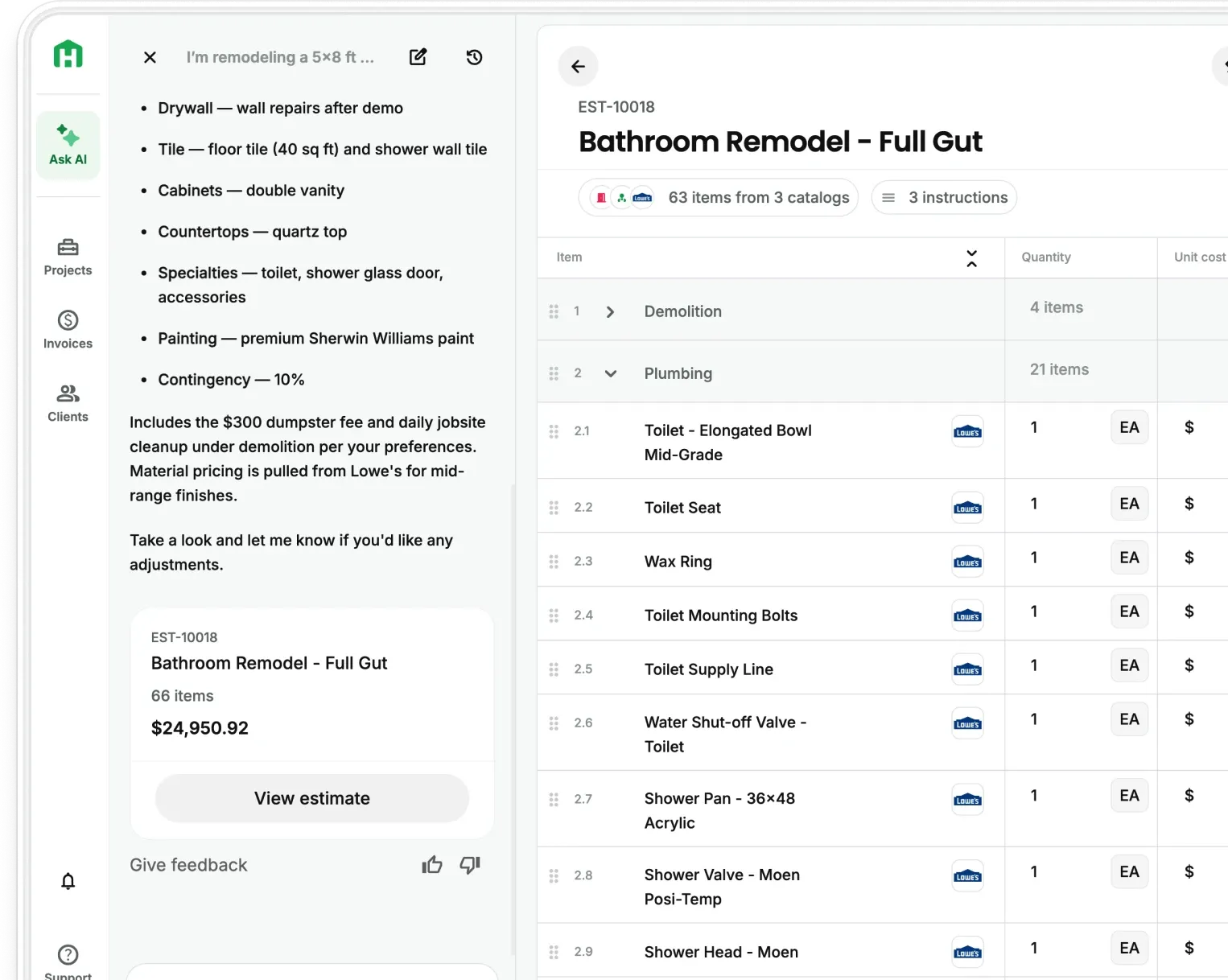
Handoff's winning AI proposals builds all of this automatically from your site visit notes — scope, line items, timeline, and professional formatting — so the proposal that goes out looks like it took two hours even if it took fifteen minutes.
How to beat competitors on a bid without lowering your price
Price rarely wins the job on its own, and it almost never wins the relationship. Clients who hire on price alone are also the ones most likely to push back on change orders, question every invoice, and leave the review that hurts.
The levers that let you win at your actual price:
Speed. 78% of homeowners hire the first contractor who responds with something useful. Getting a professional proposal out same-day or next-day closes bids before slower competitors have even scheduled a site visit. How AI estimating helps contractors price and win jobs faster breaks down the time math in detail.
Reputation. Before a client reads your number, most of them have already read your reviews. A contractor with 40 reviews averaging 4.8 stars has already done selling work that a lower price can't undo. Asking for reviews the right way — after the final walkthrough, not in the invoice email — is a habit that compounds quietly over time.
Specificity. A proposal that references the client's actual project — their kitchen, their timeline, their concern about the back wall — reads differently than a template. One or two lines of personalization signal that you were paying attention on the site visit. Most contractors don't do this.
Proof of similar work. "We finished a kitchen remodel two streets over last spring" is worth more than any amount of marketing copy. If you have it, use it.
Contractors who compete on these four things — not price — protect their margins and attract clients worth working with. Protecting your profit margin on remodeling jobs covers the downstream side of that equation once the bid is signed.
Follow-up after sending a proposal — what the silence is costing you
Most contractors send a proposal and then wait. The client goes quiet, a week passes, and eventually the contractor assumes they lost and moves on. Half the time, that assumption is wrong.
Clients go quiet for a lot of reasons that have nothing to do with your bid:
- They're still waiting on the other contractors' proposals
- They're having an internal conversation with a spouse or partner
- They're nervous about the cost and need one more conversation to get comfortable
- They genuinely forgot to reply
A simple follow-up sequence closes a meaningful percentage of these:
- Day 3 after sending: "Wanted to make sure the proposal came through clearly — happy to walk through any questions on a quick call."
- Day 7: "Checking in to see where you're at in the process. Still happy to adjust scope if the budget is a factor."
- Day 14: One final message. Keep it short. If they've moved on, that's fine — but a lot of jobs come back at this point.
The contractors who do this close 30–40% more of their submitted proposals than those who send and wait. The work was identical. The follow-up made the difference.
There's more in the full guide — including a scoring system for qualifying bids before you submit them, a proposal review checklist, and a breakdown of how to handle the most common objections clients raise after reading a bid.
Other FAQs about winning bids
What is a good bid-hit ratio for a residential contractor?
Private residential work typically benchmarks between 4:1 and 6:1 — one win for every four to six bids submitted. A ratio better than 3:1 suggests you may be bidding too selectively or pricing below market. A ratio worse than 8:1 usually points to a lead quality problem, a proposal problem, or both.
Should contractors bid on every job that comes in?
No — and this is one of the most common ways contractors waste time and damage margins. The better approach is to identify the project types, lead sources, and job sizes where your win rate is highest, and concentrate bids there. More bids doesn't mean more wins. Better-fit bids do.
How do you handle a client who says your bid is too high?
Ask what they're comparing it to before adjusting anything. Sometimes the gap is a scope mismatch — your proposal included things theirs didn't. Sometimes the client has a budget that was always unrealistic for the project. And sometimes there's a real opportunity to adjust scope without cutting margin. Don't drop price before you understand which situation you're in.
Ready to win more jobs with less manual work? Try Handoff free →